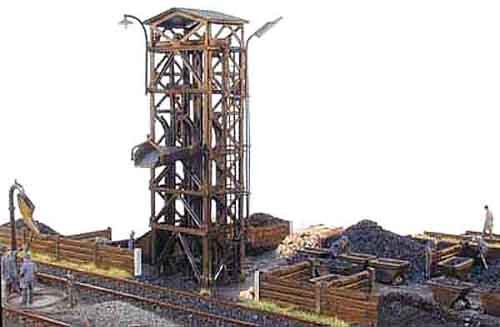
Throughout the former Austro-Hungarian Empire and in many neighbouring countries standardised small coal hopper loading stations of the Teudloff system were in use. The individual modules were strictly standardised and can be assembled in various combinations. |
The engine coal was delivered by wagons and, depending on the local circumstances of the site, shovelled or dispensed from raised tracks with self-discharging hopper trucks into the storage areas. Later transportable railway cranes or conveyor belts were also used for the discharge of the coal. |
Coal storage areas were divided into several sections. The coal was shovelled into wheeled containers and these were pushed by hand to a loader where they were hoisted and the engine coal tipped down a chute into the engine tender. On the bigger sites double tracks for the hoppers were available through which a one-way traffic system operated. The boundary walls of individual coal sections were made from old sleepers or rails and were generally very low. Often the stacks of coal rose twice as high as the walls. |
Changing tracks of the hoppers was managed by small turntables around which up to four outlets at right angles were arranged. |
The coal loader consisted of a tower of angle girders accommodating one or two discharges. Sometimes there would be an engine house (at first with a steam winch, later a somewhat smaller electric motor). The angle of the coal chute could be adjusted to allow various methods of delivery. |